Silent Treatment and Stonewalling: What's Really Happening When They Go Cold
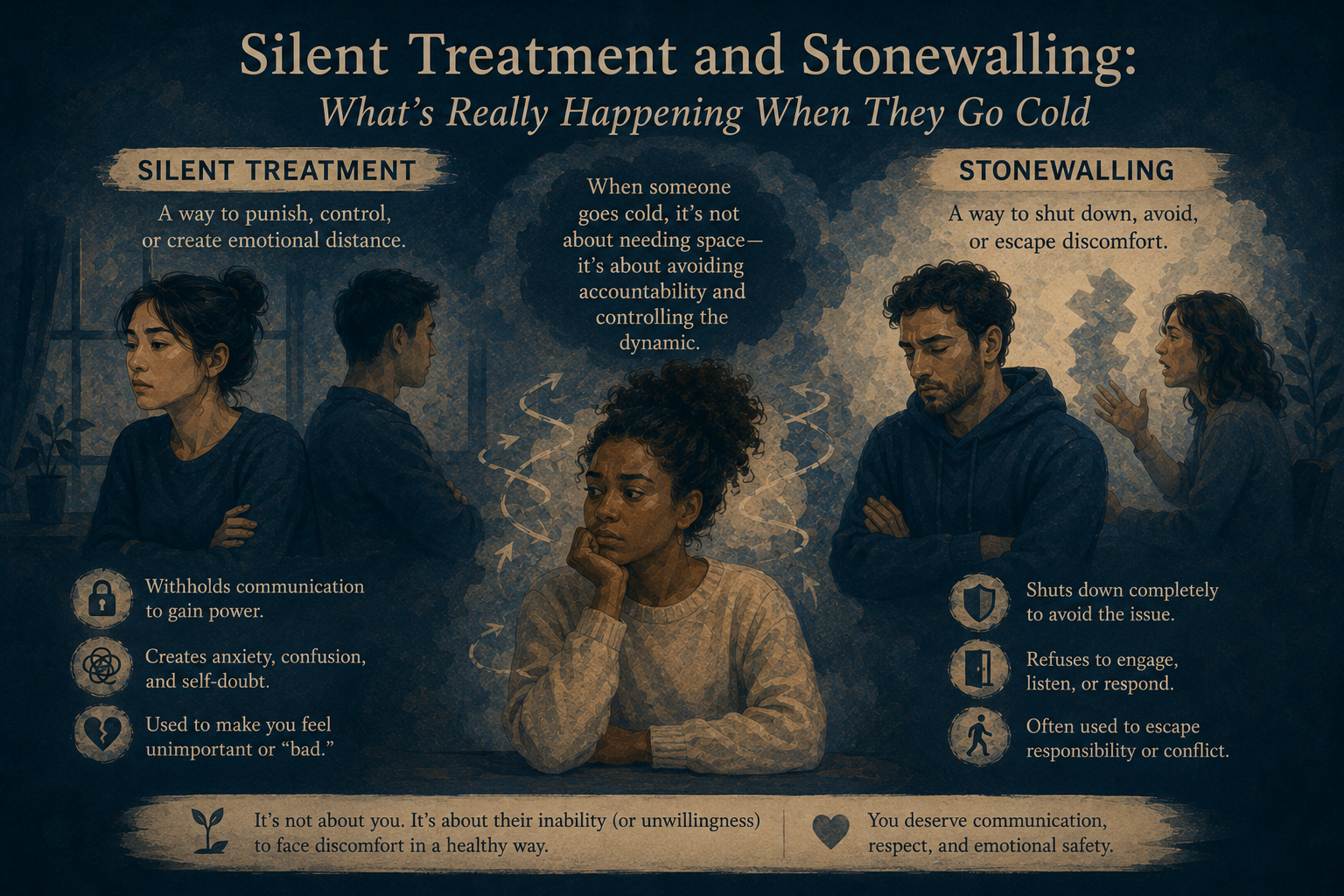
They were just here: engaged, responsive, part of the conversation. Then something happened. Maybe you set a boundary. Maybe you didn't give them what they wanted. Maybe you disagreed.
And now there's nothing. No response. No acknowledgment. Messages read and ignored. A wall where a person used to be.
You know something is wrong. You just don't know what to do with the silence.
Two Distinct Things That Look the Same
Silent treatment and stonewalling are related but not identical. Understanding the difference helps clarify what you're dealing with.
Stonewalling, as defined by relationship researcher John Gottman, is when someone shuts down during a conflict: stops engaging, goes quiet, withdraws emotionally. In Gottman's research, it's one of the strongest predictors of relationship failure, which he calls one of the Four Horsemen of destructive communication. Stonewalling often happens when someone becomes emotionally flooded, overwhelmed by the intensity of a conflict to the point where they can't continue.
In healthy relationships, stonewalling can be addressed: "I need to take a break from this conversation and come back to it when I'm calmer." The shutdown is temporary, acknowledged, and resolved.
Silent treatment is different in intent. It's the deliberate withdrawal of communication as a form of punishment or control. The goal isn't to calm down. It's to create anxiety, enforce compliance, communicate that your behavior has consequences. It's weaponized silence.
In narcissistic and high-conflict dynamics, what presents as stonewalling is usually actually silent treatment: not an overwhelmed nervous system seeking regulation, but a calculated (or habituated) use of withdrawal to manage you.
How Silent Treatment Works as a Tactic
The mechanism is straightforward and psychologically powerful.
When someone you're attached to suddenly goes silent, especially after a conflict or after you've asserted yourself, the effect is almost immediate. Anxiety rises. You review what you said, looking for the wrong thing. You consider reaching out, apologizing, softening your position. The silence becomes the primary thing in your world.
This is the point. The silent treatment routes the conversation away from the original issue and makes re-establishing contact the goal. Instead of you holding a boundary or waiting for a response to a legitimate concern, you're now focused on ending the silence, which usually requires some form of capitulation.
The silence also communicates something threatening: I can withdraw from you. My presence is conditional on your compliance. This is what happens when you don't give me what I want.
The Abandonment Lever
Silent treatment is particularly effective with people who have an anxious attachment style or early experiences of abandonment. The threat of being cut off activates deep fear, fear that is disproportionate to the actual situation but entirely real in its felt intensity.
This is not a personal failing. It's the result of attachment wiring, and it's something a skilled manipulator (consciously or not) learns to exploit. The person who knows that silence makes you anxious will use silence.
Part of healing from this pattern involves recognizing the fear as a conditioned response rather than an accurate assessment of the current threat. The silence is uncomfortable. It is not the same as abandonment, even when it feels like it.
Silent Treatment in Co-Parenting
In co-parenting contexts, silent treatment takes on practical dimensions. When a co-parent stops responding to messages about the children (scheduling, medical decisions, school matters), it's not just emotionally distressing. It creates real logistical problems and potential documentation issues.
This is where co-parenting apps become particularly important. On a platform like OurFamilyWizard or TalkingParents, non-responses are timestamped and visible. A pattern of ignoring messages about the children's welfare is documented automatically.
If co-parenting communication is being withheld as a control mechanism:
- Document the specific messages sent and the non-responses
- Note any impact on the children's care or scheduling
- Continue sending necessary communications through the agreed channel
- If urgent decisions require a response and none is coming, consult your attorney about your options
What Not to Do
Don't escalate to get a response. Sending more messages, more emotional messages, more urgent messages is exactly what the silent treatment is designed to produce. It tells the other person that withdrawal is an effective tool and that turning it up produces the desired response.
Don't apologize for things you didn't do wrong. The pull to apologize, to say or do whatever ends the silence, is strong. If you apologize for something that didn't warrant an apology, you've just taught the other person that going silent long enough produces a concession.
Don't make the silence the topic. "Why aren't you talking to me?" "You're being so immature by ignoring me." Engaging with the silence as the primary issue plays into the dynamic. The silence is a behavior. You don't need to address it. You need to continue living and communicating as needed, with or without their participation.
What to Do Instead
Maintain your timeline. If a response was needed by a certain time for a legitimate reason (a scheduling decision, a medical consent, a logistical arrangement) and that time passes without response, document it and proceed as best you can with the information you have.
Send one clear, factual follow-up if needed. Not multiple. One: "Following up on my message from [date] about [topic]. Please respond by [date] so we can [action]." Then wait. If no response: document and proceed.
Don't fill the silence emotionally. Resist the urge to send messages that express hurt, confusion, or anger about the silence. Those responses are what's being sought.
Regulate your own nervous system. The anxiety the silence produces is real and needs to be addressed, just not with the person who caused it. Talk to someone. Go for a walk. Write in a journal. The goal is to keep the anxiety from driving decisions about communication.
What Silence Tells You
Here is the reframe that many people in this situation eventually find useful: a person who uses silence as a weapon is showing you exactly how they handle conflict and disagreement. They are showing you that your needs and concerns become invisible to them when you don't comply with their preferences.
That information is not comfortable. It is real.
You don't have to make decisions based on it today. But you can stop wondering whether you did something wrong and start understanding what the silence is actually communicating about the other person.
Receiving the silent treatment after asserting yourself or setting a limit? The DARVO analyzer can help you understand what's happening and how to respond without giving up your ground.