Parallel Parenting: A Complete Guide to Making It Actually Work
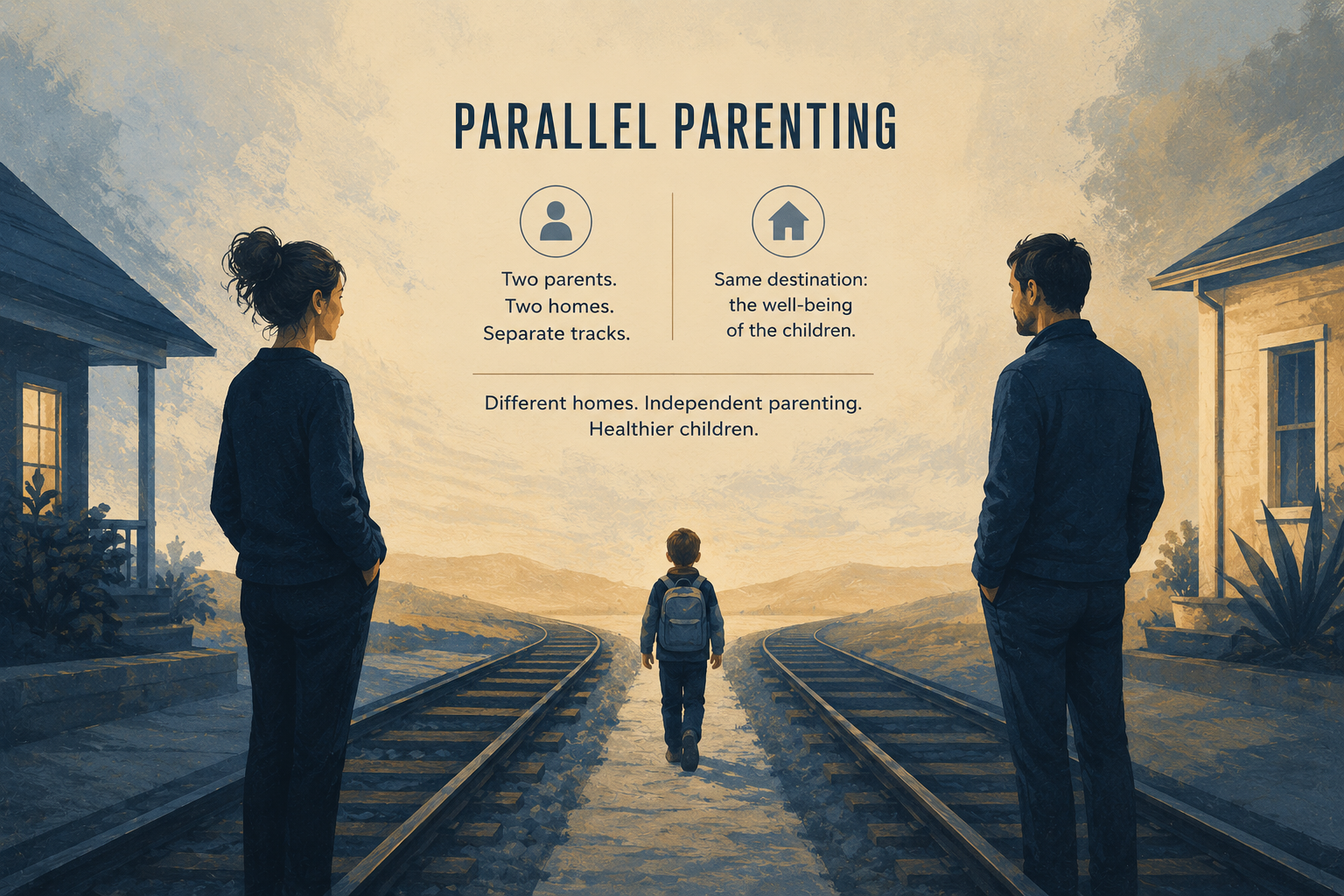
Most co-parenting advice assumes you can tolerate direct interaction with your ex: some good faith, willingness to negotiate, shared commitment to the kids that usually outweighs personal conflict.
If you're co-parenting with a narcissistic or high-conflict ex, that advice isn't built for you. You need parallel parenting.
What Is Parallel Parenting?
Parallel parenting minimizes direct contact and interaction. Each parent parents independently in their own time without requiring cooperation, negotiation, or good faith from the other.
Think of two trains on separate tracks toward the same destination. They don't need to coordinate moment to moment. Each runs its route. The children travel between them.
Cooperative co-parenting assumes both parents can work together for the children's benefit. Parallel parenting acknowledges that for some families, parental conflict harms children more than limited cooperation helps. The goal shifts from "we work together" to "we stay out of each other's way."
When Parallel Parenting Is the Right Model
Parallel parenting fits when:
- Direct communication consistently produces conflict, manipulation, or escalation
- One parent is high-conflict, narcissistic, or abusive
- Children are harmed by witnessing parental conflict
- Every attempted negotiation becomes a battle
- Court-ordered contact is necessary but cooperative parenting isn't realistic
It's not a permanent failure. Some families move toward more cooperation as conflict drops. Many don't, and that's acceptable too.

The Core Principles
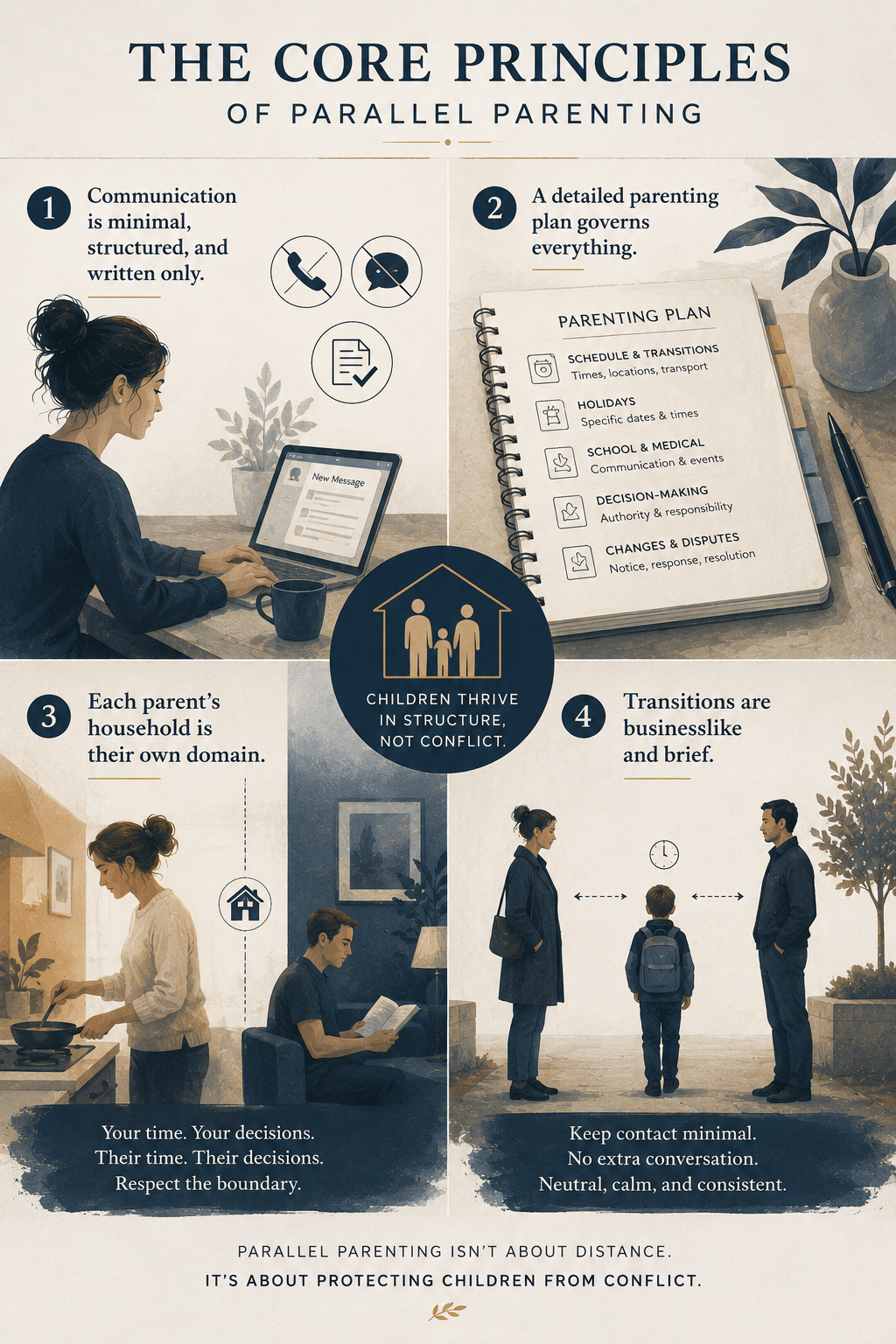
1. Communication is minimal, structured, and written only
In parallel parenting, phone calls, in-person talks, and texts beyond logistics are eliminated or sharply limited. Communication goes through:
- A dedicated co-parenting app (OurFamilyWizard or TalkingParents)
- Email (if agreed and documented)
- Attorneys when necessary
Verbal agreements create ambiguity and deny you documentation. In high conflict, "I never said that" arrives within days. Everything in writing. Everything through the documented channel.
2. A detailed parenting plan governs everything
A vague plan generates conflict. In parallel parenting, the plan should address dispute points with specificity:
- Pickup and dropoff times, locations, transport responsibility
- Holiday schedules with specific hours (not just "Christmas" but "December 24 at 10am through December 25 at 6pm")
- School communication, medical appointments, school events
- Decision-making authority: independent vs. joint decisions
- Process for schedule changes (notice required, response timeline, dispute handling)
The more specific the plan, the fewer openings for manipulation and manufactured conflict.
3. Each parent's household is their own domain
During your parenting time, you make parenting decisions: meals, bedtimes, activities, routines. You don't need the other parent's approval for your household in your time.
During their time, the reverse holds. You don't get to comment on, interfere with, or monitor their household. That means releasing control over something you couldn't control anyway, and it's often the hardest part.
4. Transitions are businesslike and brief
If handoffs require contact, keep it minimal. No conversation beyond what the children need. In high conflict, neutral locations (school, designated exchange areas, a grandparent's home) specified in the plan can eliminate direct contact entirely.
Setting It Up
Get a comprehensive parenting plan in writing. If you're early in the process or revisiting a vague plan, work with your attorney on detail. Courts can order specificity when the other party won't agree.
Agree on the communication channel and stick to it. Both parties should use the same documented platform. If you're on OFW and they're texting, address it in writing: "Per our agreement, I'll be communicating through the co-parenting app. Please send logistics there." Then don't answer texts about co-parenting matters.
Define what "emergency" means. In high conflict, "emergency" gets weaponized. Define in the plan what counts (life-threatening medical situation, natural disaster, immediate safety concern) vs. logistics that can wait for normal response windows.
Set response time expectations. Establish that co-parenting app messages get a response within 24–48 hours for non-urgent matters. That reduces pressure to be instantly available and constant monitoring.
Keep your side boring on purpose. Parallel parenting rewards parents who look steady in the record: short messages, plan citations, no lectures. You're not trying to win the thread. You're trying to make the paper trail readable for a judge, mediator, or attorney months from now.
Handling the Hard Parts
When they violate the plan
Document the violation specifically and immediately. Minor issues may warrant one documented message noting the discrepancy. Significant violations: consult your attorney. Don't self-help or retaliate. Follow the plan yourself regardless of what they do.
When the children are caught in the middle
Kids moving between parallel households need low-conflict transitions and parents who refrain from trash-talking the other parent. You control your household. Make it a soft landing: consistent, warm, free of the conflict that lives in the other home.
When they try to communicate outside the established channel
One brief redirect: "Please send co-parenting communications through the app." Then don't engage with the message content. If it's urgent and genuinely about children's safety, handle safety; don't handle co-parenting drama in the wrong channel.
When you need to make a joint decision
Joint decisions in parallel parenting happen in writing, with stated positions and documented outcomes. Your attorney can intermediary when needed. Parenting coordinators (neutral professionals for co-parenting disputes) exist for exactly this situation and can be court-ordered.
When they bait you into breaking parallel rules
Provocative messages are designed to pull you off the written channel or into a fight you can't win in text. Treat bait as information, not invitation: log it, respond only to logistics if required, and use your attorney or coordinator for everything else. The win is not the last word. The win is the record that shows who stayed on the plan.
What Parallel Parenting Is Not
It's not abandoning your children to whatever happens at the other house. You still advocate through appropriate channels: therapist, school, pediatrician, court when necessary.
It's not ignoring genuine safety concerns. Documented reason to believe children are at risk requires professional intervention, not a co-parenting message.
It's not permanent warfare. The goal is conflict low enough that children can move between households without being caught in it. Whether that eventually becomes more cooperation or stays parallel, stability is the point.
What the Research Says
Research on high-conflict co-parenting consistently shows children fare better with reduced inter-parental conflict, even when that means less cooperation between parents. Children don't need their parents to like each other. They need safe transitions, contained conflict, and households where they can simply be kids.
Parallel parenting, done well, can provide that.
When a message on the app feels designed to bait you or rewrite the plan, paste it into DARVO.app/analyze before you reply. You'll see the tactics and get brief, court-safe wording that doesn't feed the fight.