Gaslighting vs. Narcissism: Why Anyone Can Gaslight (Not Just Narcissists)
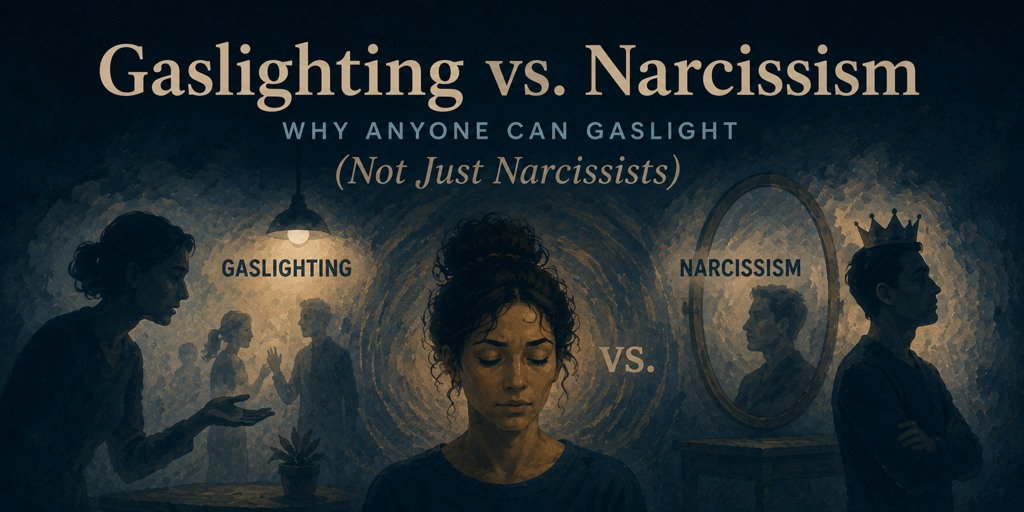
You learned the word "gaslighting." The next thought is often "so they must be a narcissist." Online, the two terms get swapped so often they sound like the same thing. They're not. One names what someone does. The other names a broader personality pattern. That difference changes what you focus on when you're trying to stay clear.
What Gaslighting Actually Is
Gaslighting is a behavior: repeatedly causing someone to doubt their memory, perception, or sanity through denial, misdirection, and contradiction.
The name comes from the 1944 film Gaslight, where a husband dims the gas lights and insists nothing changed when his wife notices. You don't need the plot for co-parenting Tuesday night. You need the move: repeated messages that make you doubt what you saw, heard, or agreed to.
Gaslighting is something a person does, not a label you wear forever. People with many personalities and motives can do it, with different levels of awareness. Your job in the moment is usually simpler: notice the pattern and protect your clarity, not win a diagnostic debate in your head.
What Narcissism Actually Is
Narcissistic Personality Disorder (NPD) is a clinical diagnosis: a persistent pattern of grandiosity, need for admiration, and lack of empathy across contexts, assessed by a mental health professional.
In everyday talk, "narcissist" often means anyone who seems self-focused, manipulative, or low on empathy. That makes the word easier to reach for and harder to use precisely.
Narcissism sits on a spectrum. Many people have narcissistic traits without meeting NPD criteria. Many people with NPD are never diagnosed. And many people without NPD still gaslight under stress, shame, or habit.
The Overlap (Real and Significant)
Gaslighting shows up often in relationships with strong narcissistic dynamics. When someone's self-image can't tolerate being wrong, accountability often gets answered by attacking the facts: "that didn't happen," "you're too sensitive," "you're imagining things."
If chronic gaslighting is part of your co-parenting thread, narcissistic traits in the other person may be worth understanding with a professional. But overlap isn't identity. Not everyone who gaslights has NPD. Not everyone with NPD leads with gaslighting. Related, not identical.
Who Else Gaslights
Treating gaslighting as behavior opens a fuller picture of who does it and why.
People protecting themselves from shame. Someone who did harm and can't face the shame may rewrite the story to survive their self-image. It may not feel strategic to them. It can still hurt you deeply.
People who learned it. If adults in your childhood denied reality and dismissed feelings, you may repeat those patterns without noticing.
People with other personality structures. Borderline traits, for example, can involve intense emotion and memory disruption that feels like gaslighting to a partner, sometimes without a plan to manipulate. How you respond may differ from deliberate gaslighting.
People under extreme stress. Legal pressure, divorce, job loss: when their story is threatened, some people deny and deflect. Not acceptable, different in character from years of habit.
Institutions. Companies, schools, and medical systems can deny patterns employees or patients report. Same mechanics, often with more authority behind the denial.
In co-parenting, you may see a mix: a defensive ex who rewrites last week's pickup, a school administrator who "didn't witness" what your child reported, a family member who only heard their side. The label changes. The move is similar: your account gets shrunk until theirs fills the room.
Why the Distinction Matters
Merging the two terms has costs.
It can lead to over-diagnosis. If everyone who gaslights you "must be a narcissist," you may use a clinical frame where shame, stress, or learned communication fits better.
It can lead to under-recognition. If you've decided they're "not a narcissist," you may dismiss real gaslighting because it doesn't match a full clinical picture.
It centers diagnosis over impact. Whether or not NPD applies, your memory is being challenged and your reality contested. The harm doesn't require a label.
It can feel like a false finish line. "They're a narcissist" can feel like the whole explanation. Pattern, history, and what you need next usually matter more than any single label.
What to Focus On Instead
Rather than "are they a narcissist?" try questions that describe your lived experience:
- Is this a pattern or a one-off?
- When I raise a concern, do they engage the substance or attack my perception?
- Do I leave exchanges doubting myself in ways I didn't when I walked in?
- Has my trust in my own memory eroded over time?
Those answers shape what you need, with or without a diagnosis on the other side. Parallel parenting, tighter documentation, therapy for you, a consult with an attorney: those decisions flow from pattern and impact, not from whether a stranger on the internet would call them a narcissist.
When a message thread has you spinning, DARVO.app/analyze flags tactics in plain language so you can respond to the pattern, not chase the right label.