DARVO vs Gaslighting: What's the Difference? (And Why Spotting Both Matters)
You walk away from the conversation feeling foggy. You raised a concern — calmly, clearly — and somehow you're the one apologizing. Your memory feels unreliable. You're not sure what just happened.
If you've ever tried to research what this experience is called, you've probably bumped into two words: gaslighting and DARVO. They get used almost interchangeably online, but they're not the same thing — and the difference matters more than most articles let on.
One is a tactic. The other is a pattern that uses that tactic as a component.
Here's how to tell them apart, why it matters for how you respond, and what to do when you're dealing with one, the other, or both at the same time.
Quick Definitions
Gaslighting is a manipulation tactic specifically designed to make you doubt your own reality — your memory, your perception, or your sanity. It's the deliberate distortion of facts to destabilize someone else's sense of what's true.
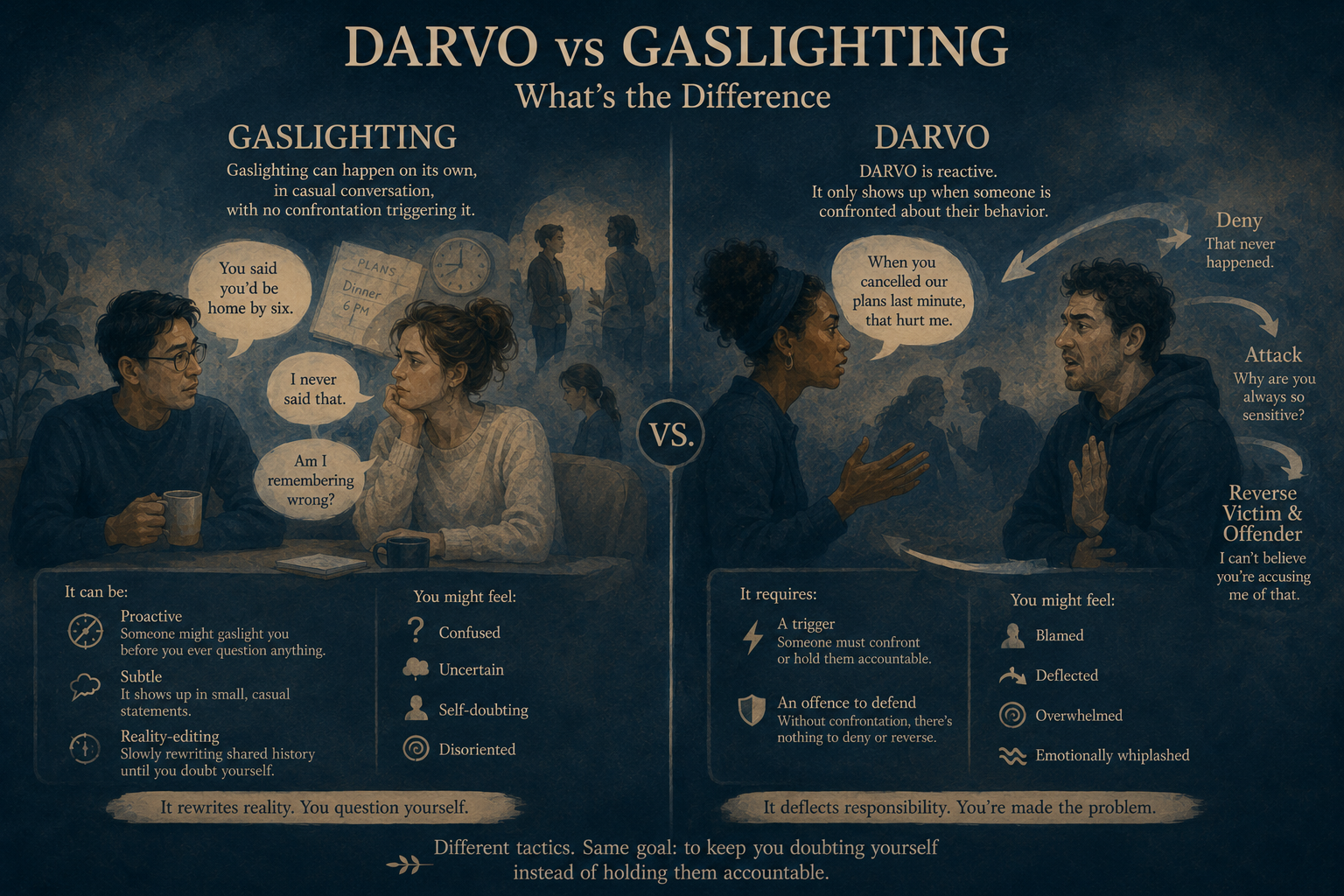
DARVO is a three-step defensive response pattern used when someone is confronted about their behavior. It stands for:
- Deny the behavior
- Attack the person confronting them
- Reverse Victim and Offender
DARVO was named by psychology researcher Dr. Jennifer Freyd at the University of Oregon, who has spent decades studying how perpetrators respond when held accountable.
Here's the key relationship between them: all DARVO contains gaslighting (in the "Deny" phase). But not all gaslighting is part of a DARVO sequence.
Think of gaslighting as the ingredient, and DARVO as the recipe that uses that ingredient as one of three steps.
The Core Difference
Gaslighting can happen on its own, in casual conversation, with no confrontation triggering it. Someone might gaslight you proactively — slowly editing the shared history of your relationship, casually saying "you said you'd be home by six" when you said no such thing, asserting events that didn't happen.
DARVO is reactive. It only shows up when someone is confronted about their behavior. It needs a triggering accusation or concern to defend against. Without confrontation, there's nothing to deny, no one attacking to attack back, no offender role to reverse.
So:
- Gaslighting can be ambient. Drip-fed over weeks, months, years.
- DARVO is acute. A burst of denial-attack-reversal in response to being called out.
Both can leave you confused. But the type of confusion is different.
After gaslighting, you might walk away thinking "I'm losing it. My memory is unreliable."
After DARVO, you might walk away thinking "How did I end up as the bad guy when they were the one who did something wrong?"
What to do when it happens
Name the pattern to yourself: “This is DARVO. The original issue hasn't been addressed.” You don't have to defend against the counter-accusations. Hold the original topic — in your own mind, even if the conversation doesn't allow it.
Side-by-Side: Same Topic, Different Tactics
Imagine your co-parent didn't show up for a scheduled pickup. You raise the issue.
Pure gaslighting response:
"That wasn't a scheduled pickup. We talked about this last week — you said you'd take the kids. Honestly, you've been so forgetful lately. I'm worried about you."
Notice what this does: it rewrites the agreement, plants doubt about your memory, and adds a faux-concerned tag designed to make you question your own mental clarity. There's no attack, no role reversal. Just reality distortion.
Full DARVO response:
[Deny] "That wasn't a scheduled pickup — we'd never agreed to that. [Attack] You always do this. You twist things and then act surprised when I'm 'late.' This is exactly why everyone tells me you're impossible to co-parent with. [Reverse] I can't believe you're attacking me when I'm the one who actually shows up for our kids. I'm doing my best here and you keep coming after me. This is so unfair."
Same triggering issue. But the DARVO response doesn't just distort reality — it pivots completely. The original concern (the missed pickup) is buried under three layers of defense: denial, character assassination, and a victim-narrative flip.
By the end of the DARVO response, you're not having a conversation about a missed pickup anymore. You're defending yourself against an accusation you didn't see coming.
When Gaslighting Is Inside DARVO
This is where most people get confused.
Look back at the DARVO response above. The first step — "That wasn't a scheduled pickup, we'd never agreed to that" — is gaslighting. It's reality distortion.
So when DARVO is happening, gaslighting is happening. The Deny phase is, by definition, an attempt to make you doubt your version of events.
But DARVO doesn't stop there. It adds two more layers: the attack on you, and the reversal of who is the wronged party. That's what makes DARVO more disorienting than gaslighting alone — you're not just being asked to doubt your facts, you're being asked to apologize for raising them.
How To Tell Which One You're Dealing With
Use these questions in order:
1. Did this happen in response to me raising a concern?
- Yes → likely DARVO. The defensive trigger is the giveaway.
- No, it came out of nowhere → likely gaslighting on its own.
2. Did they pivot from the behavior to attacking me as a person?
- Yes → DARVO. Pure gaslighting tends to stay focused on the facts being distorted; it doesn't usually need to assassinate your character.
- No, they just kept distorting the facts → gaslighting without the full DARVO sequence.
3. Did I end up defending myself instead of getting an answer about the original issue?
- Yes → DARVO. The whole point of DARVO is to flip the conversation so you become the defendant.
- No, but I'm questioning my memory of something they said → gaslighting.
You can have one without the other. You can have both at once. Naming what's actually happening is the first step out of the fog.
Why Responding Differently Matters
The tactics overlap, but the response strategy isn't identical.
For gaslighting, the antidote is documentation and external reality-checks.
Keep records. Save the texts. Use a co-parenting communication platform that timestamps everything. When your memory is being chronically attacked, having an external record that you can return to — and that another person (a therapist, a friend, a court) can also look at — is what restores your clarity.
For DARVO, the antidote is non-engagement with the reversal.
The trap of DARVO isn't just the denial — it's the pull to defend yourself against the attack and to comfort the manufactured victim. Every minute you spend defending or comforting is a minute the original concern stays buried.
The DARVO-proof response is short:
"I raised a specific concern. I'd like to come back to that."
Then you don't engage with the attack. You don't comfort the claimed victim. You don't justify, argue, defend, or explain. (This is also known as the JADE trap — and DARVO is engineered to pull you straight into it.)
If they continue the DARVO, you exit:
"I'm not continuing this conversation right now."
Then you document what happened, and you protect the original concern in writing.
Why People Confuse the Two
A lot of survivor content online uses "gaslighting" as a catch-all for "any manipulation that left me confused." That's understandable — gaslighting became a household term in the late 2010s and early 2020s, and it captures the experience of being manipulated even when it isn't technically accurate about the mechanism.
But there's a real cost to the conflation.
If you assume every manipulation is gaslighting, your response strategy stays narrow: document, reality-check, hold your ground on facts. That works for gaslighting. It doesn't fully work for DARVO, because DARVO is engineered to pull you out of the fact-based lane entirely and into emotional defense mode.
Knowing the difference lets you match the response to the tactic.
What These Tactics Have in Common
Both gaslighting and DARVO share three underlying features:
They prioritize control over honesty. Neither is interested in resolving the actual issue — both are interested in maintaining the speaker's preferred version of reality.
They exploit your good faith. Both work because reasonable people give other people the benefit of the doubt. You don't expect someone to fabricate events. You don't expect a confrontation to be flipped into an accusation against you.
They erode trust in yourself. Whether the mechanism is reality distortion (gaslighting) or role reversal (DARVO), the effect is similar — you start trusting your own perception less.
This is why naming them matters. The moment you can label what's happening in real time, the spell starts to break.
The Bottom Line
Gaslighting is a tactic. DARVO is a pattern. They overlap — gaslighting lives inside the Deny phase of DARVO — but they aren't the same thing, and they don't call for identical responses.
If you've been confused about which one you're experiencing, that confusion is part of how both tactics work. The clarity comes from learning to recognize the structure: Is someone distorting your reality (gaslighting) or running the full three-step pivot to make you the bad guy (DARVO)?
You don't have to be a clinician to spot it. You just need the language.
DARVO.app analyzes messages you receive and names the tactic in real time — including DARVO, gaslighting, projection, and more — so you can stop second-guessing yourself and respond strategically. Try it free →