Why Your Body Still Flinches: Nervous System Rewiring After Narcissistic Abuse
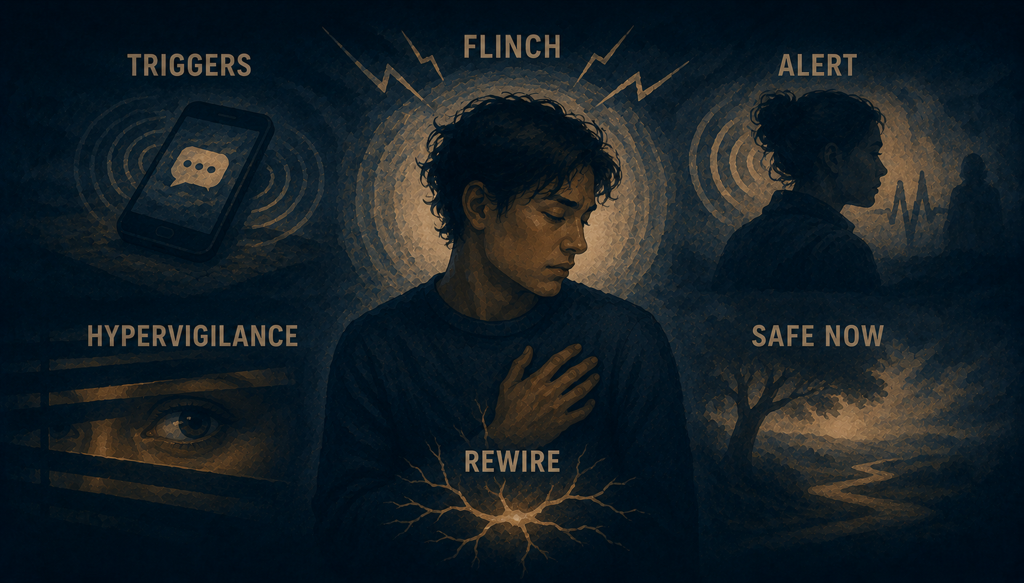
You're out of the relationship. On paper, you're safer. You can explain that to anyone who asks.
And still your body acts like you're not.
Your phone buzzes and your stomach drops before you read who it's from. A certain tone in someone's voice, even a kind partner or a coworker, sends you into alert mode. A message from your co-parent's number can flood you with adrenaline while you're standing in the grocery line, even when the text is boring logistics.
That's not weakness, and it's not proof you're "still stuck on them." Your nervous system learned a job under real pressure. It kept you braced when bracing was rational. It hasn't fully learned yet that the old rules don't apply.
What Happened to Your Nervous System
Your autonomic nervous system (the part that runs fight, flight, freeze, and fawn without asking permission) works by pattern matching. It notices cues that used to mean danger and fires the alarm when those cues show up again.
In a long abusive or high-conflict relationship, you lived with unpredictability: not knowing when the next blow-up would come, what would trigger it, or how bad it would get. That keeps threat detection turned up for months or years.
Over time, your brain linked specific signals to danger: a notification sound, a phrase they always used, the pause before they typed "we need to talk." You didn't choose those links. Repetition built them.
When the person is gone, the links often stay. Your body can react to the ping or the tone even when nothing bad follows. That can make you wonder if you're broken. You're not. You're carrying a trained response that made sense in context.
What's Going On Physically
A few pieces help explain why this feels so automatic.
The amygdala is your brain's smoke alarm for threat. It can trip before you've finished reading the message. That's why you sometimes feel activated before you can name why.
Well-worn pathways. Paths your brain used again and again during the relationship get easy to travel. Anger, dread, or shutdown can show up fast because the route is familiar.
Stress hormones. Long periods of stress can leave cortisol elevated. That affects sleep, memory, focus, and how quickly you calm down after a spike. Those shifts don't flip back the day you move out. You might notice you're foggy in meetings, snappy with your kids, or unable to finish a simple task after a two-line text. That's your body still running the old program.
The vagus nerve helps your body shift from alarm back to calm. After long stress, that "calm down" capacity can be weaker until you train it back. Small daily practices matter more than one big insight.
Symptoms You Might Recognize
Startle response. You jump at sudden sounds or movement. Your system is still scanning for the next hit.
Cue-specific anxiety. A ringtone, a name on the screen, or conflict in the next room sends you into high gear because your body remembers what used to follow.
Trouble relaxing. Even at home or on a good day, part of you stays on watch. Rest can feel unfamiliar or unsafe.
Sleep problems. Trouble falling asleep, waking at small noises, heavy or vivid dreams.
Body holding stress. Tight shoulders, headaches, stomach issues. The alarm isn't only in your thoughts.
If co-parenting means you still get messages from the same person, your nervous system may get mixed signals: safer in some ways, still triggered by the channel. That's common, not a sign you're "broken."
What Actually Helps Rewire
Your nervous system can change. What helps most reaches the body, not only the thinking part.
Somatic work. Trauma-informed yoga, breath-focused therapy, or somatic experiencing target how stress lives in muscle and breath, not just the story you tell about it.
EMDR. For some people, bilateral stimulation in EMDR lowers the charge on specific memories or cues tied to the flinch.
Vagal toning. Slow breathing with a longer exhale, humming, gentle exercise, and cold water on the face are simple practices that can strengthen your body's ability to come down from alarm. They're physiological, not just "positive thinking."
Predictability. Steady routines, reliable people, and environments where words match actions give your system new data: not every ping means danger.
Time. With support and without ongoing threat, baselines often shift. Progress isn't always linear, but it's real. A bad week doesn't erase a good month.
Therapy that fits. A therapist who understands coercive control or high-conflict divorce can help you sort what's injury from what's manipulation still landing in your inbox. You don't have to do the nervous-system work alone.
Be Patient With the Part That's Still Protecting You
The flinch is a record of what you survived. Your nervous system adapted to keep you as safe as it could.
Now the job is to teach it, slowly, that old cues don't always mean what they used to. That takes repetition of safety, not willpower alone.
When a message still wrecks your afternoon, paste it into DARVO.app/analyze. Separating manipulation tactics from ordinary conflict in the text can ease the spiral of "maybe I'm overreacting" while your body catches up.